
As Nigeria’s independence loomed in the 1950s, two opposing camps of thought struggled to define the nation’s post-colonial future. The liberal nationalists believed that democracy offered the best chance of achieving Nigeria’s developmental aspirations while radical nationalists like Chike Obi believed that liberal democracy for such a diverse polity would lead to polyphonic anarchy. Only a strongman in the order of Kemal Ataturk and Gamal Abdel Nasser could lead Nigeria’s charge to fulfill its manifest destiny.
Dr Obi’s vision was of a neo-Stalinist dictatorship and collectivist order in which coercive violence was a necessary component. His advocacy possibly provided the intellectual justification for the January 15 coup. Emmanuel Ifeajuna, one of the five majors had been a student at the University of Ibadan when Obi held court. Yet the mathematical genius was not alone in his conviction that Nigeria needed an iron hand. Even Aminu Kano had pondered the possibility of a Nigerian Kemal or Mussolini and intellectuals like Tai Solarin welcomed the coup, as did the media in general.

Despite its high-sounding pretensions, January 15 was a catastrophe. That its zealous protagonists eliminated politicians from every part of the country except their own kin ensured that their revolutionary motivations were lost in the impenetrable thicket of ethnic suspicion and paranoia. Nnamdi Azikiwe noted that violence had never been part of the nationalists’ anti-colonial agitation and declared the coup a “national calamity.” Obviously, the First Republic had been tested by episodic violence and arguably, events such as the brutal repression of the Tiv riots and the disturbances in the western region helped set the stage for military intervention. As Claude Ake wrote, the degeneration of politics into warfare propelled the specialists of warfare into a lead role. Once democrats succumbed to using anti-democratic means, disaster was inevitable. Yet, the First Republic was essentially a liberal dispensation and the coup outlawed debate and dialogue and enthroned violence in their stead.

Successive juntas proffered a narrative in which politics itself was the sin of which the nation had to be cleansed in order to be reborn. Political parties and para-political organizations were instruments of strife and corruption. Thus, politics and its practitioners were accordingly prohibited. But the idea at the heart of messianic militarism was enlightened authoritarianism. Its exponents insisted that dictatorship and discipline were prerequisites for prosperity at the expense of democratic freedoms. Nigerians made this pact with the devil wholeheartedly. In forty years, they only protested against one coup – the 1976 putsch in which Murtala Mohammed was assassinated.

As Kingsley Mbadiwe once remarked, “The first democracy is the democracy of the stomach.” Bread mattered more than ballots and the soldiers could provide bread in abundance. With the oil boom, soldiers were cast as miracle workers who could solve national problems with ‘immediate effect’. When the veteran nationalists, Azikiwe and Hezekiah Davies respectively proposed experiments in diarchy (a governing partnership of civilians and soldiers) and triarchy (adding traditional chiefs to that partnership), they were basically articulating popular opinion.

After the riotous Second Republic, politicians became outlaws hunted by military inquisitors. Liberals and leftists celebrated the overthrow of that dispensation. Adebayo Williams wrote in 1986, “People prefer tyranny to liberty which leaves their pockets drier, their religious freedom threatened and their children murdered.” Military rule would not have endured without the society’s complicit idolatry of messianic soldiers, and without intellectuals marketing the virtues of enlightened authoritarianism. Progressive liberals compromised their values and accepted militarism as a necessary evil. They had come to believe implausibly that military dictators could midwife liberal democracy. For leftists who had idealized Murtala as a forerunner to a full-fledged socialist regime, the right military regime was acceptable. These beliefs facilitated Buhari’s disciplinarian state, Babangida’s right wing corporatism and Abacha’s thuggish totalitarianism, all of which included progressives and civil society actors.

Adebayo Williams wrote in the last days of Babangida’s regime, “There will always be tyrants and sadists. But we have a right to insist on exchanging lower forms of tyranny for higher forms.” This quest for higher forms of tyranny led progressives into curious positions. Gani Fawehinmi once argued that Nigeria needed “a period of grueling and gruesome militant intervention” and that “Democracy is a luxury that must follow after enlightened and principled dictatorship has settled the society.” Several pro-democracy activists welcomed Sani Abacha. Indeed, this dalliance with Abacha terminally polarized the Campaign for Democracy and aborted its promise as a broad-based anti-military coalition. To their credit, when liberals and leftists realized their error, they made for the barricades but the damage was already done. By 1999, the pro-democracy groups were too weak to mount a credible political challenge.

Why do these histories matter? We came out of the military era with a less than total sense of closure. It may even be argued that Nigerians did not come to a profound consciousness of democracy’s virtues but rather became dissatisfied with each military regime’s apparent hijack by particular ethnic interests. Military rule was not rejected because it was morally wrong but because it failed to deliver prosperity. The basis for the return to civil rule in 1999 was pragmatic and utilitarian rather than moral. There was no sudden realization that destructive means cannot achieve constructive ends. We may well question the sustainability of the Fourth Republic given the vexatious incompetence of its leading actors thus far. The belief in messianic strongmen dies hard.

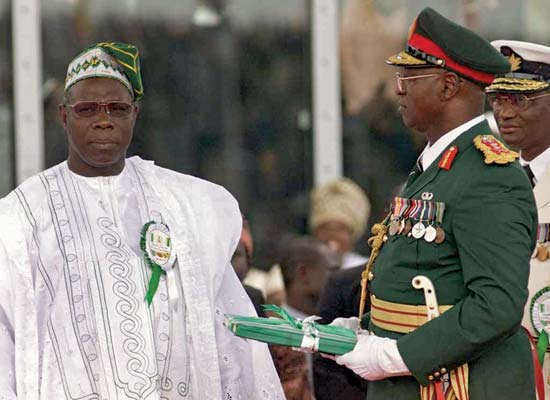
These histories matter because the odious legacies of militarism endure. It is no accident that a cabal of retired generals sponsored Obasanjo, a retired military Head of State, to the presidency in 1999 or that the leading opposition figure in the past three elections has been another ex-Head of State, Buhari. Obasanjo’s successor Umar Yar’Adua owed his presidency less to his modest gubernatorial accomplishments in Katsina than to his inheritance of the vast political machine created by his late brother, Shehu Musa Yar’Adua, another veteran soldier-politician. Consider the rebirth of several retired military officers variously as senators, governors and ministers. In 1999, military officers had acquired enough wealth to finance their reincarnation as democrats. Some even touted their experience in military regimes as qualification for office. This was akin to Nazi operatives seeking office in post-war Germany and touting their service to the Third Reich as an advantage. But then Germany achieved closure after the darkest period of its history. Nigeria did not.

Militarism casts a long shadow. As long as retired military officers remain significant political players, warlord politics and the militarization of political conversation and public life will continue. Coup d’états and election-rigging are similar pathologies rooted in the culture of impunity and violence, and both subvert popular sovereignty. A military-sponsored constitution has created an imperial presidency and provided legalistic fortifications of the unitary command and control paradigm that undermines federal democracy. The current generation of political operatives was socialized in an era of authoritarian lawlessness as evidenced by their larcenous proclivities. The military’s abolition of debate devalued ideology and promoted money, ethnicity and religion as the directive principles of our politics.
Even the frequent eruptions of sectarian violence stem from the military era. As the military vandalized and plundered the state, people took refuge in tribal and confessional fortresses. Recession caused Nigerians to seek social security in ethnicity and religion. Repression ensured the politicization of ethnicity and religion and their emergence as touchstones of civic expression. Today’s ethnic militias and religious extremists are children of the military era. The post-military presidency, being an authoritarian institution, invites unhealthy sycophantic and cultic adulation which foils the possibility of building strong institutions and discouraging aspiring strongmen.

Violence as a tool of political redemption is a grossly limited, if oversold, commodity. Historically, dreams of Utopia forged by brute force produced martial monstrosities. The modernizing autocracy was a political mirage. In our diverse society, we need liberal democracy to provide space for plural perspectives. We need the wisdom of the multitudes rather than presidential omniscience. Our democracy will often be slow, ponderous and even mediocre until ideologies crystallize. Our task is to accelerate this dialectic and speed the day of ideological clarity. In the process, we must also exorcise the spirit of violence from the body politic. In the past, a national haste often led us to seek social and economic miracles purportedly retailed by militarism. Such haste informed our plunge into the Fourth Republic without first scrutinizing its military-made constitution. But nation-building is not done in haste.
There remains the problem of how to address the provocative excesses of a “democratic” kleptocracy. Either we forge new weapons of civic resistance and solidarity and renew our faculties of social engagement; or appeal to false messiahs that materialize in times of crisis. For when we consider the injustices of our age, the criminal disparities between the fortunes of the people and their representatives, we can only conclude that confrontation is inevitable. For the good of Nigerian humanity, that confrontation is best choreographed by the messengers of reason rather than the avatars of chaos.


